

Cardea Group | Executive Search Partners, Legal & Compliance for the Buy-Side
The inevitable fork every growing asset management firm eventually faces: A critical legal or compliance seat suddenly becomes vacant. The business can’t wait. The search feels urgent. And almost inevitably, someone says, “Let’s just bring in a consultant. We don’t have time to train someone.” On the surface, it’s a practical decision. In reality, it’s often based on the wrong question. Instead of asking, “Can a new hire get up to speed quickly enough?” ask, “Is this role meant to solve today’s problem, or build tomorrow’s capability?”
Why “not enough time to train” misses the point
Ramp-up time is very real. Research on new-hire onboarding generally puts functional competence at 30–90 days and full mastery of a complex role at 6–12 months. If a seat genuinely requires independent regulatory judgment (exam readiness, novel structuring questions, direct SEC or NFA engagement) a short window can be a legitimate issue.
But at most alternative asset managers, “junior” or “associate” legal and compliance roles aren’t entry-level in the way that phrase implies. Compliance associate postings at hedge funds and PE firms routinely ask for 3–5+ years of experience, and legal counsel roles in this space are frequently BigLaw associates making a lateral move. These hires already know what the Advisers Act is. They need to learn your firm’s specific book of business, systems, and people. That’s a context ramp measured in weeks, not a subject-matter ramp measured in months.
If a hire is being written off as “too slow to train” inside a six-month window, it’s worth asking whether the real issue is training time at all, or something else; budget category, management bandwidth, or genuine uncertainty about whether the seat is permanent.
Run the actual numbers first
Before deciding, put both options in the same units: total cost for the period you actually need coverage. Associate/analyst-level legal and compliance compensation (Cardea Group, 2025 Legal & Compliance Compensation Report):
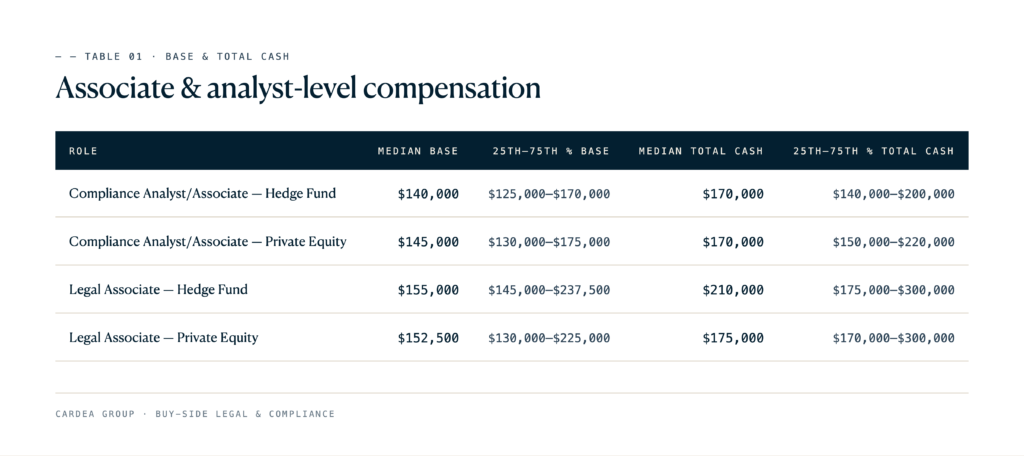
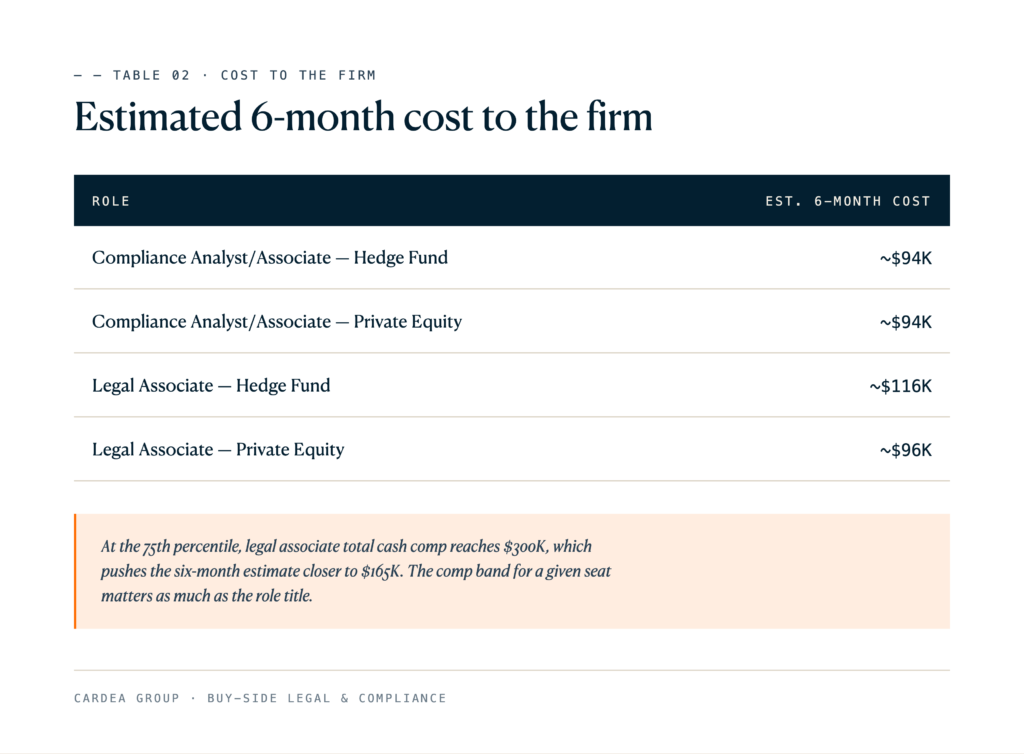
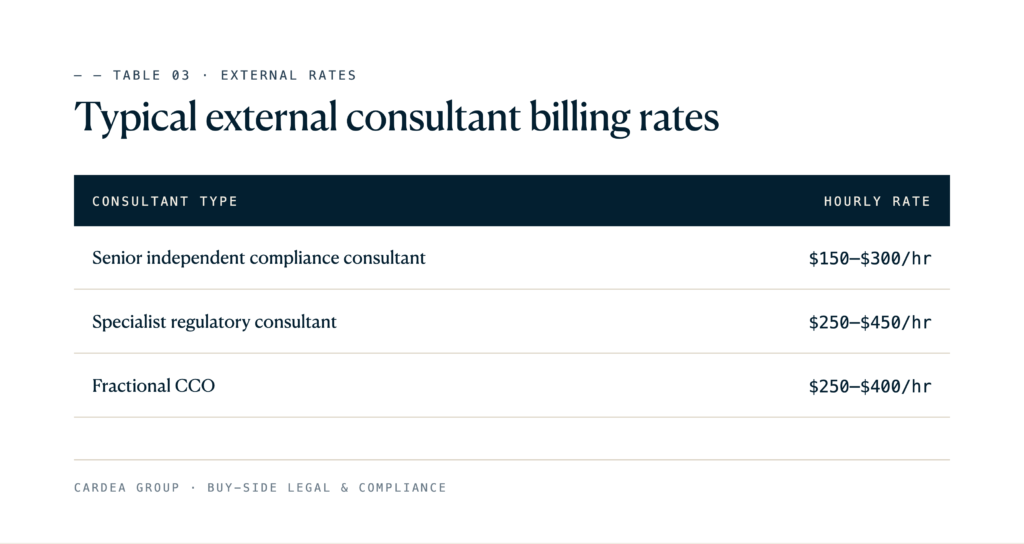
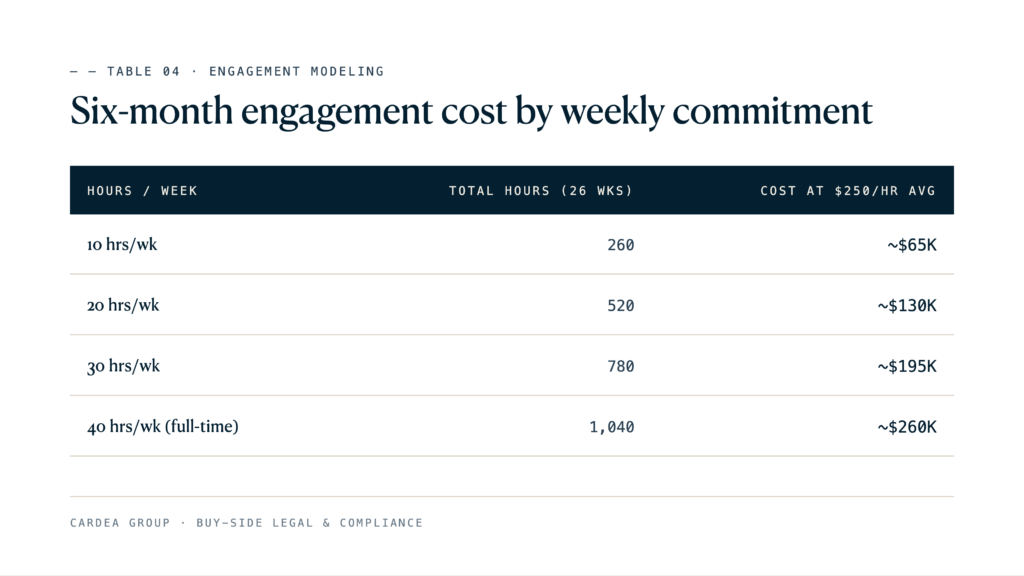
Lay these tables side by side and the picture sharpens a bit. At the associate and analyst comp levels, a consultant used lightly (10–15 hours a week, roughly $65K–$100K over six months) lands close to what the full-time employee costs for the same period. The two options genuinely compete in that range.
But legal associate roles at the higher end of the comp band already carry six-month costs of $115K–$165K on their own. A consultant would need to stay well under 20 hours a week to actually undercut it. At anything close to full-time hours, the consultant is routinely the more expensive option, sometimes by a wide margin, and that’s before factoring in what happens after month six.
The consultant route is cost-efficient only when the actual workload is part-time. If the role needs near-full-time coverage, “consultant is cheaper” usually isn’t true at the compensation levels this industry pays. It just feels true because the invoice arrives as a single line item instead of a payroll commitment.
Four questions that actually determine the answer
1. Is the need temporary, or is “temporary” doing some cover-up work?
If the seat would still exist in 18 months regardless of who fills it now, you’re just deferring a permanent hiring decision and paying a premium to delay it. A consultant makes the most sense when the underlying need is genuinely uncertain: a fund closing question, an exam-driven spike in workload, a bridge while a function gets restructured or absorbed elsewhere.
2. What are the real weekly hours, not the job description hours?
Job descriptions default to full-time framing even when the actual workload doesn’t require it. Estimate honestly. If it’s truly 10–15 hours a week of work, a consultant is probably the more efficient use of money. If it’s 30+ hours a week, run the cost table above before assuming the consultant is the “simple” choice.
3. What’s actually required; subject-matter expertise or firm-specific context?
Scope tends to track with fund size. Cardea Group’s search data shows that at funds under $1B AUM, the most common first internal compliance hire is a Compliance Associate, and the role is explicitly narrow and execution-focused (salary-and-bonus level work, not judgment-heavy). That scope only shifts toward deeper judgment and specialization once firms cross the $1B and $5B AUM marks, where Deputy CCO and specialist roles start appearing.
So if the open seat is genuinely associate or analyst level, the underlying work is more likely to be coverage and execution than the kind of independent regulatory judgment that actually takes months to build. If the gap is deep regulatory judgment nobody in-house currently has, a consultant’s expertise is the point, and it’s worth paying for. If the gap is bandwidth, i.e.: someone needs to handle marketing review, trade surveillance, or personal trading monitoring that a reasonably experienced hire could pick up in a few weeks with proper onboarding, the “training time” objection is weaker than it sounds, because there isn’t much new subject matter to learn.
4. What do you lose when the engagement or the hire ends?
A consultant walks away with the knowledge and firm-specific context they’ve built, with no succession plan behind them. If the seat is still needed, you’re launching a search at the end of that consultant’s tenure, after already carrying the cost of their salary for however long they were in the role.
A junior or associate hire who doesn’t get real investment in their ramp-up can become a turnover risk of their own. Replacing an employee can cost 50–200% of their annual salary once you factor in the vacancy, the search, and the ramp time for whoever comes next. A strong onboarding process is one of the simplest ways to protect that investment. Our New-Hire Onboarding Guide was built around the challenges our search partners tell us they see in the early stages of a new hire’s tenure, from communication and self-awareness to self-advocacy, expectations, and knowing how to ask for what they need. It gives firms a practical framework for helping new legal and compliance professionals get integrated, productive, and set up for long-term success from day one.
There’s also a factor worth considering: an independent compliance consultant may serve multiple funds, including competitors. Confidentiality agreements can protect information, but they don’t change the fact that the consultant is building institutional knowledge across multiple firms. This reality matters more to some funds than others.
A CONSULTANT PROBABLY WORKS BETTER WHEN:
- The actual weekly hours needed are meaningfully below full-time
- The gap is genuinely deep subject-matter expertise the internal team doesn’t have and won’t need permanently
- The underlying need is uncertain enough that you’d rather not commit to a permanent seat yet
- You need someone productive in week one, no exceptions
A FULL-TIME HIRE PROBABLY WORKS BETTER WHEN:
- The role needs something close to full-time coverage
- The seat will exist in some form regardless of who’s in it a year from now
- The main gap is firm-specific context rather than deep technical expertise the market is short on
- You want the institutional knowledge to stay in the building after the initial ramp period
Most of the time, the deciding factor isn’t training time at all. It’s whether the actual hours required and the actual duration of the need line up with what each option is built for. Running the numbers before the conversation, rather than defaulting to whichever option sounds lower-commitment in the moment, tends to surface a very different answer than “there’s not enough time to train someone.”
Working With Cardea Group
Cardea Group is a New York-based executive search firm that works exclusively with alternative asset managers on legal and compliance hiring. Since 2009, we’ve conducted more than 850 searches across hedge funds, private equity firms, private credit platforms, family offices, and venture capital firms, placing professionals from Compliance Analyst through Chief Compliance Officer and General Counsel. If your compliance function is under more pressure than it was a year ago, and the team structure hasn’t changed to match it, that’s a conversation worth having.
Sources
- Cardea Group — 2025 Legal & Compliance Compensation Report (proprietary search and placement data)
- AirMason — How Long Does Onboarding Take? Realistic Timelines by Role
- Hyring — What Is a Ramp-Up Period?
- efinancialcareers — Compliance Associate/Analyst listings, Hedge Fund, New York
- ConsultFees — Compliance Consultant Fees: Benchmarks & Pricing
- Arootah — Fractional/Contract Chief Compliance Officer rate posting
- Qooper — Cost of Employee Turnover
- American Progress — Business Costs to Replacing Employees