
Ask most Chief Compliance Officers where they’re spending their time, and you’ll hear a version of the same story. They’re balancing compliance alongside legal, operations, or another critical function. The work gets done, but not always in the right order. One deferred project becomes another, and the backlog grows. An SEC examination has a way of exposing just how much has been pushed aside.
At Cardea Group, we’ve conducted more than 850 legal and compliance searches across hedge funds, private equity firms, private credit platforms, family offices, venture capital firms, and private funds. The most consistent pattern across all of them is structural. The compliance leaders usually know their material. The structure around them decides whether the firm can respond quickly when the environment shifts, and structure is the variable most within a firm’s control.
What’s actually moving the market
Anyone following Washington closely knows the current administration has pulled back hard on the rulemaking pace set between 2021 and 2024. Many of the more ambitious SEC proposals from that period have been shelved or narrowed, and others sit in procedural limbo. For compliance leaders at hedge funds and private equity firms, that can feel like relief. In practice it has changed the shape of the risk.
What we hear from the compliance leaders and fund principals we work with is that exam readiness is now the dominant operational concern. The rulemaking anxiety of the prior cycle has given way to a more immediate question: if the SEC scheduled an examination tomorrow, would this team be ready? At a substantial number of firms, the honest answer is probably not as ready as we should be.
A slower enforcement stretch also doesn’t erase the records created during it. Kujo Osei of Integrity Growth made this point at the 2025 PEI Forum, noting that the SEC works with a five-year look-back, so communications generated today stay reviewable well after the environment shifts again. His specific example was texting during deal flow, which remains one of the more common documentation gaps we hear about.
Technology hasn’t taken the pressure off staffing either, though plenty of firms expected it would. ACA’s 2025 survey found that fund AI usage doubled in a single year, from 40% of firms to 80%. Once everyone has the same tools, the routine monitoring and testing layer gets faster, and what’s left is interpretation. Someone still has to read the findings and decide what they mean, and that work sits with a person senior enough to make the call.
Exam readiness comes down to people and process, backed by documentation that proves both are working. A gap in any one of them creates exposure the other two can’t cover for. The root cause we see most often sits with the first: the wrong person, or too few people, carrying the function.
The dual-hatted executive bottleneck
The structure we see most often at funds in the $4 billion to $10 billion range is built around a dual or triple-hatted C-suite executive, a CFO/CCO or COO/CCO, and sometimes one person wearing all three hats. Early on, that makes sense. When a fund launches or scales through its first few hundred million in AUM, consolidating oversight in one senior, trusted executive is a reasonable use of resources. The trouble is how long firms hold onto the arrangement, usually well past the point where it serves them.
When a regulatory change demands a coordinated response, or an exam cycle begins, the bottleneck sits in the same place every time: the executive trying to handle the compliance demand while also running finance and operations, often investor relations too. Response time slows. Prioritization turns reactive. Work that a dedicated compliance professional could have handled at the associate or officer level escalates instead to the most senior person in the room, who has the least spare bandwidth of anyone.
The incoming hire who steps into a firm that has run this way for years almost always finds the same thing: a backlog of compliance work that never needed executive attention in the first place. These firms had capable CCOs. They were missing the supporting layer underneath, and that’s where the backlog came from.
The alternative came up at the 2025 PEI Forum, where Jackie Cangero of GI Partners described keeping compliance in every deal and every fundraising call from day one, as part of a joint legal and compliance team. Her compliance lead won’t have every answer in the moment, but they’re in the transaction from the start rather than reviewing it after the fact. That arrangement depends on someone having the capacity to sit in those meetings, which is exactly what a dual-hatted executive doesn’t have.
Growth outpaces compliance staffing, almost every time
The firms that call Cardea are rarely in crisis. “Underwater but not drowning” is the phrase that keeps coming up in these conversations. The call usually follows a recognizable event: a jump in AUM or a new fund launch, sometimes a management transition, and often times it’s more than one of these at once. The business grew faster than the compliance infrastructure supporting it, and the gap finally became impossible to ignore.
None of this happens through carelessness. Growth is the priority, and compliance staffing responds to growth instead of anticipating it. By the time the need is undeniable, the firm is already behind. The search that follows is reactive, and the new hire spends their first months catching up instead of building.
The firms that handle the transition well share one habit: they make the staffing decision before the pressure turns into a crisis. The trigger varies. Sometimes it’s investor feedback, sometimes an examination that’s completed or coming up. More than once it’s been outside counsel telling the firm candidly that its compliance team is straining under the workload. Whatever prompts it, the firm that moves before it absolutely has to ends up in a materially better spot than the one that waits.
What compliance infrastructure looks like at each stage
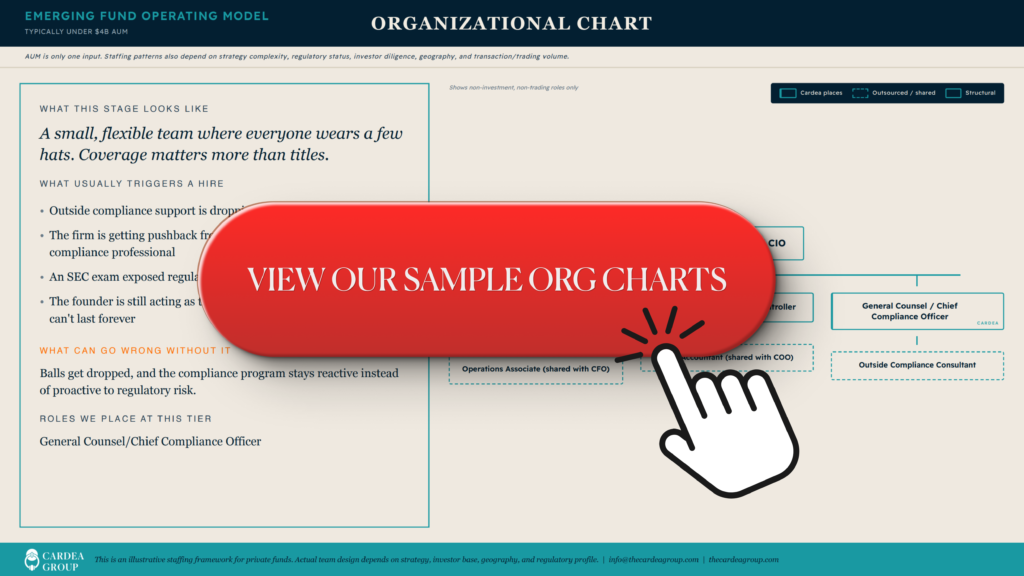
Based on Cardea’s search activity across the buy-side, the structure that supports genuine regulatory readiness follows a recognizable pattern as AUM grows. We’ve mapped the full progression in our peer org charts, which cover four operating stages from emerging manager through global platform. One caveat before walking through them: AUM is one input among several. Strategy complexity, regulatory status, investor diligence, geography, and trading volume all shape what a team actually needs, so treat the stages as a framework rather than a formula.
Under $4 billion, the emerging fund stage, the team is small and everyone wears a few hats. Coverage matters more than titles. Compliance typically sits with an outside consultant while the founder acts as the de facto lead, and the first dedicated hire is usually a combined General Counsel/Chief Compliance Officer. The trigger tends to be investor pushback on the absence of a dedicated compliance professional, or an SEC exam that exposed risks the outsourced arrangement missed.
From $4 billion to $10 billion, the scaling stage, the most common setup pairs a GC/CCO with a dual COO/CFO (or an executive holding all three titles), supported by a Compliance Associate or Paralegal. Firms at this stage tend to add a dedicated Compliance Officer once the dual-hatted arrangement starts showing strain, and some begin splitting the combined executive seats apart entirely. The searches here are usually the GC/CCO seat itself, plus the Compliance Officer and Compliance Associate or Paralegal roles beneath it.
Between $10 billion and $25 billion, the institutionalizing stage, the shift that matters most is separating finance from compliance. Dual-hatted roles that worked fine at $5 billion become liability exposure by $15 billion. The GC, CCO, COO, and CFO operate as distinct functions, the compliance reporting line runs from the Compliance Officer or Associate directly to the CCO instead of to an executive juggling multiple mandates, and the legal side starts adding depth of its own through counsel hires (transactional or fund formation focused) brought in as needed. The searches we run most often at this stage: GC, CCO, Compliance Officer or Associate, Paralegal, Legal Counsel, Transactional Attorney, and Fund Formation Attorney.
Above $25 billion, the global platform stage, compliance and finance are fully separated and the function needs real depth as well as coverage, built with succession and specialization in mind. A wrong hire at the GC or CCO level creates fund-level regulatory exposure, which is why replacement searches at this scale almost always run confidentially. The structure typically pairs the GC with an Associate GC or Regulatory Counsel, and the CCO with a Compliance Officer and Compliance Associate beneath them. The trigger at this tier is often a GC or CCO who has become the bottleneck to high-stakes initiatives, or leadership asking for genuine succession planning in the firm’s most regulated functions.
Across all four stages, the full set of seats we fill runs from GC and CCO through Deputy CCO, VP Compliance, transactional counsel, and paralegal roles, on a retained and confidential basis.
The case for a designated compliance officer before the exam
This started as an opinion rather than a data point, though it’s since picked up support from people who sit far closer to the exam process than we do: the single most useful thing a fund can do in the six months before an SEC examination is make sure a designated compliance officer owns that function, instead of a dual-hatted executive who also owns finance or operations.
At the 2025 PEI Forum, John Reinert of Kirkland & Ellis pointed to a question examiners ask routinely, some version of “Do you have the staffing and support to carry out your duties?” It sounds procedural. The answer tells an examiner a great deal about how seriously the firm treats the function, and lean staffing tends to produce longer, tougher exams along with harder questions about whether leadership is behind the program at all.
Reinert also flagged recurring issues under 206(4)-7 where the CCO simply didn’t have the right background for the role. When the person in the seat is an administrator or a temp, or otherwise lacks the depth the role calls for, it colors how examiners read everything else the firm shows them. Credibility starts with a qualified person holding the title.
How that person handles the exam matters too. Igor Rozenblit of Iron Road Partners noted that examiners pay close attention to how a CCO communicates. Clear, calm answers from someone in full command of the facts build trust quickly and set the tone for the entire review, which is a different skill from knowing the rulebook and worth screening for directly.
Examiners assess your policies and procedures, and they read the org chart while they’re at it. A dedicated compliance officer says the firm takes the function seriously enough to staff it. A CFO who also serves as CCO says compliance is one of several things that person is juggling, and that invites closer questions about whether it’s getting enough attention. Hiring a designated compliance professional before the exam won’t guarantee a favorable outcome, but it’s one of the clearest signals a firm can send.
The questions worth asking now
If you’re a managing partner, CCO, GC, or COO at an alternative asset manager, guessing whether regulatory pressure rises or falls under this administration is mostly wasted effort. The productive question is whether your compliance staffing is proportionate to your current size and the risk you’re actually carrying.
A few worth answering honestly. Is the person responsible for compliance also responsible for something else? If so, at what AUM does that arrangement stop making sense for your firm? When did you last run a compliance gap assessment, and who ran it? If an SEC examination began next quarter, who would own the response, and would they have the time and organizational support to run it well?
On the gap assessment question, one practical note from the PEI Forum discussion: mock audits can often be partially reimbursed through D&O insurance, up to roughly 10%, which removes some of the cost objection that usually stalls them.
These are the questions Cardea’s clients are usually working through when they call us, and every one of them is easier to answer before a trigger event forces the conversation. If you’re already turning them over, reach us at info@thecardeagroup.com.when they call us, and they’re easier to address before a trigger event forces the conversation.
Frequently Asked Questions
| What is the most common reason compliance teams at alternative asset managers aren’t ready for an SEC examination? Based on Cardea Group’s experience across more than 850 buy-side legal and compliance searches, the most common reason is structural: a dual or triple-hatted executive, such as a CFO/CCO or COO/CCO, holds the compliance function alongside other significant operational responsibilities. When an exam begins, that person doesn’t have the bandwidth to manage the response at the speed and depth the situation requires. The bottleneck isn’t knowledge; it is organizational capacity. Firms that address this by adding a dedicated compliance officer before exam pressure builds are consistently better positioned than those that wait. |
| At what AUM should a hedge fund or private equity firm separate its CFO and CCO functions into dedicated roles? There is no universal threshold, but the pattern observed across Cardea’s search activity suggests that dual-hatted CFO/CCO or COO/CCO structures begin creating meaningful liability exposure around $10 billion to $15 billion in AUM. Below that level, the structure can function adequately with the right supporting hire at the Compliance Officer or Associate level. Above it, the complexity of both functions typically exceeds what one person can manage without one of them receiving insufficient attention. The trigger for separation isn’t always AUM alone: a new fund launch, a post-fundraise expansion into new strategies or jurisdictions, or a post-exam deficiency finding will often accelerate the timeline. |
| Does having a dedicated compliance officer actually affect how an SEC examination goes? In Cardea’s view, yes. The operational case is straightforward: a dedicated compliance officer has the bandwidth to manage the examination response without competing priorities. But the more important factor is cultural. SEC examiners assess whether a firm has a genuine culture of compliance, not just adequate documentation. A designated compliance professional signals organizational commitment to the function. A CFO who also serves as CCO signals that compliance is one of several items that person is managing, which tends to invite more scrutiny. Firms with dedicated compliance staffing proportionate to their size and complexity tend to have shorter, less disruptive examinations. |
| How quickly can a compliance hire be made when an alternative asset manager is already under examination or facing a regulatory deadline? Cardea Group’s search process runs approximately 40 percent faster than the industry average because of pre-qualified, relationship-based pipelines of passive candidates who aren’t actively on the job market. For time-sensitive situations, including those triggered by an active examination or deficiency finding, we’ve hired dedicated compliance officers, Deputy CCOs, and Compliance Associates in compressed timelines. That said, the best outcomes come from searches conducted before the pressure becomes acute. Candidates who know a firm is in distress command different terms and bring different motivations than candidates who join a firm that’s building proactively. |
Working With Cardea Group
Cardea Group is a New York-based executive search firm that works exclusively with alternative asset managers on legal and compliance hiring. Since 2009, we’ve conducted more than 850 searches across hedge funds, private equity firms, private credit platforms, family offices, and venture capital firms, placing professionals from Compliance Analyst through Chief Compliance Officer and General Counsel. If your compliance function is under more pressure than it was a year ago, and the team structure hasn’t changed to match it, that’s a conversation worth having.